


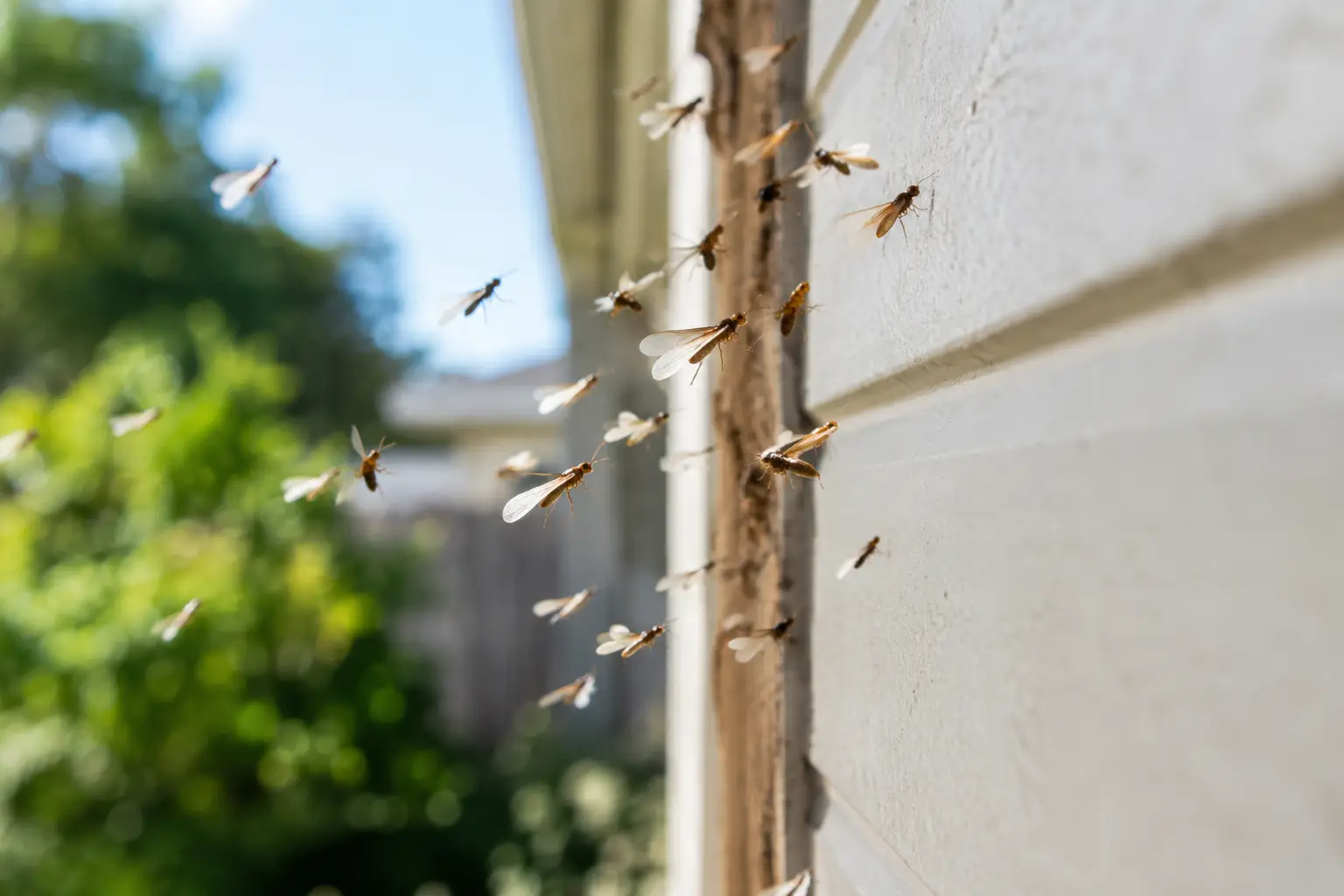
A small cluster of winged insects around a window, light fixture, or doorway can be easy to dismiss. But knowing how to identify flying termites can make a major difference to the protection of your property. These insects may be the visible sign of a mature termite colony nearby, or a warning that new colonies could soon be established around your home or business.
Flying termites do not always mean that structural damage has already occurred. However, they do warrant prompt attention, especially when you find them indoors, see discarded wings, or notice other signs of termite activity. A professional inspection can clarify what you are dealing with and help prevent a small warning sign from becoming a costly repair issue.
What Are Flying Termites?
Flying termites are reproductive members of a termite colony. Often called swarmers or alates, they emerge when weather and moisture conditions are favorable, usually after rain or during warm, humid periods. Their purpose is to leave an established colony, mate, shed their wings, and begin a new colony.
Most worker termites remain hidden in soil, wood, wall voids, or other protected areas. That is why seeing flying termites can be unsettling: it is one of the few times termites become highly visible. A swarm may last only a short time, but its presence should not be ignored.
For property owners and facility managers, the key question is location. Flying termites outdoors may be emerging from a colony in the surrounding environment. Flying termites inside, particularly near wooden structures, window frames, skirting boards, or ceiling areas, deserve a more urgent assessment.
How to Identify Flying Termites by Their Appearance
The most common source of confusion is flying ants. Both insects can appear in groups, are attracted to lights, and may emerge after rain. Looking closely at the body shape and wings will usually reveal the difference.
Straight antennae and a broad waist
Flying termites have straight, bead-like antennae. Their bodies are relatively uniform in width, without the narrow, pinched waist associated with ants. Flying ants have bent or elbowed antennae and a noticeably constricted section between the thorax and abdomen.
This difference can be difficult to spot if the insects are moving quickly. If possible, collect a few specimens in a clean container or take a clear close-up photo before cleaning them away. It gives a pest professional a better chance of confirming the species.
Four wings of similar length
A flying termite has four long wings that are similar in size and shape. The wings are usually translucent, delicate, and extend well past the body. A flying ant also has four wings, but its front pair is noticeably longer than its rear pair.
Termite wings detach easily after a swarming event. Finding piles of matching, translucent wings on a windowsill, near a door, beneath lights, or along floor edges is often more informative than seeing the insects themselves.
Color is less reliable than body shape
Flying termites are often dark brown, black, or tan, depending on the species and life stage. Flying ants can appear in similar colors. For that reason, color alone is not a dependable way to identify them.
Focus instead on the antennae, waist, and wing proportions. These physical characteristics provide a far more accurate distinction when you are deciding whether termite activity may be present.
Where You Are Most Likely to Find Them
Flying termites are drawn to light, so they often gather around indoor lights, exterior lamps, windows, glass doors, and illuminated entryways. Indoors, they may appear suddenly in a single room and disappear just as quickly after the swarm has ended.
They may also emerge near places where moisture and wood meet. Pay attention to areas around plumbing penetrations, bathrooms, kitchens, utility rooms, ground-floor walls, wooden door frames, and locations with past leaks. Subterranean termites depend on moisture and typically travel from the ground to food sources through concealed routes.
In commercial settings, examine storage rooms, false ceilings, service corridors, loading areas, timber fixtures, and any zone where water intrusion has occurred. For F&B, retail, office, and industrial facilities, early reporting is particularly valuable because termite damage can affect fixtures, inventory areas, and business continuity without being immediately visible.
Signs That Support a Flying Termite Identification
A swarm on its own is a reason to investigate, but it becomes more concerning when combined with evidence of an active termite colony. You may notice mud tubes running along walls, foundations, pipes, or structural surfaces. These narrow, earth-colored tubes help subterranean termites travel while retaining moisture and avoiding exposure.
Wood damage may also be present, although it is not always obvious from the surface. Termites often consume wood from within, leaving a thin outer layer of paint or timber intact. Doors may become harder to close, floors can feel uneven or hollow in isolated spots, and wood may sound hollow when gently tapped.
Other warning signs include blistering paint, unexplained cracking around wooden features, small piles of shed wings, or a faint clicking sound inside severely affected wood. None of these signs confirms the extent of an infestation on its own, but together they justify a thorough inspection.
Flying Termites Indoors vs. Outdoors
The response should be proportionate to what you see. A few flying termites outside near a porch light may have originated from vegetation, nearby soil, or another property. It does not automatically prove that termites are inside your building.
However, an indoor swarm changes the picture. When dozens or hundreds appear from a wall, ceiling void, floor edge, or wood feature, the chance of nearby activity is higher. Even if the insects entered through an open window, repeated swarming indoors or recurring piles of discarded wings should be professionally assessed.
Do not rely on a surface spray as a solution. Killing the visible swarmers may remove the immediate nuisance, but it does not locate or eliminate the colony. Termite control requires identifying the likely source, evaluating risk areas, and selecting a treatment approach suited to the property and termite species.
What to Do When You See Flying Termites
Start by avoiding unnecessary disturbance. Vacuuming up insects and shed wings is fine after you have documented what you found, but avoid tearing open walls, pulling apart timber, or applying household chemicals into cracks. These actions can make an inspection more difficult and may drive termites into less visible areas.
Take note of the date, time, exact location, approximate number of insects, and whether wings were found. A photograph of the insects beside a coin or other size reference can also help. If there has been recent rain, a plumbing leak, flooding, or moisture damage, record that information as well.
Then arrange a qualified termite inspection. A trained technician can distinguish termites from ants, assess likely entry points, inspect vulnerable areas, and recommend treatment and prevention measures. The right response depends on factors such as construction type, soil contact, moisture conditions, the extent of activity, and whether the building is residential or commercial.
How to Reduce the Risk of Future Termite Activity
Prevention is not a guarantee against termites, but it can reduce the conditions that support them. Keep wood, cardboard, and stored paper away from exterior walls and damp ground. Repair leaks promptly, maintain proper drainage, and avoid allowing water to collect near the building perimeter.
Where possible, keep soil and mulch from covering weep holes, vents, or lower wall details. Inspect timber decking, planter boxes, wooden fences, and outdoor structures that sit close to the building. These features can create concealed pathways or moisture-rich conditions if they are poorly maintained.
Regular inspections are particularly worthwhile for properties with a previous termite history, extensive timber elements, recurring moisture issues, or nearby construction activity. Long-term protection is built on early detection and targeted control, not simply reacting when insects become visible.
When Professional Help Is the Sensible Next Step
If you have found flying termites indoors, discarded wings in multiple areas, mud tubes, or suspicious wood damage, do not wait for more obvious signs. Termites can remain concealed while causing progressive damage to timber and other cellulose-based materials.
Servcare approaches termite concerns with careful inspection, science-backed treatment methods, and prevention planning tailored to the property. For homeowners, that means clearer guidance and reassurance. For businesses, it means addressing risk with minimal disruption and protecting the premises, operations, and reputation.
A flying termite sighting is not a reason to panic, but it is a useful reason to act. Capture the evidence, protect the area from further moisture exposure, and have the property assessed before a hidden colony has more time to grow.