

Subterranean termites rarely announce themselves before damage begins. They travel through soil, enter through concealed gaps, and feed inside timber where daily activity can go unnoticed. When choosing between termite baiting vs soil treatment, the right answer depends on how termites are accessing the property, the construction of the building, and whether the priority is immediate protection, colony control, or both.
For homeowners and facility managers, this is not simply a choice between two products. It is a treatment strategy that should be based on a detailed inspection. A professionally designed plan can protect structural elements, reduce recurring activity, and provide greater peace of mind without unnecessary disruption.
How termite baiting works
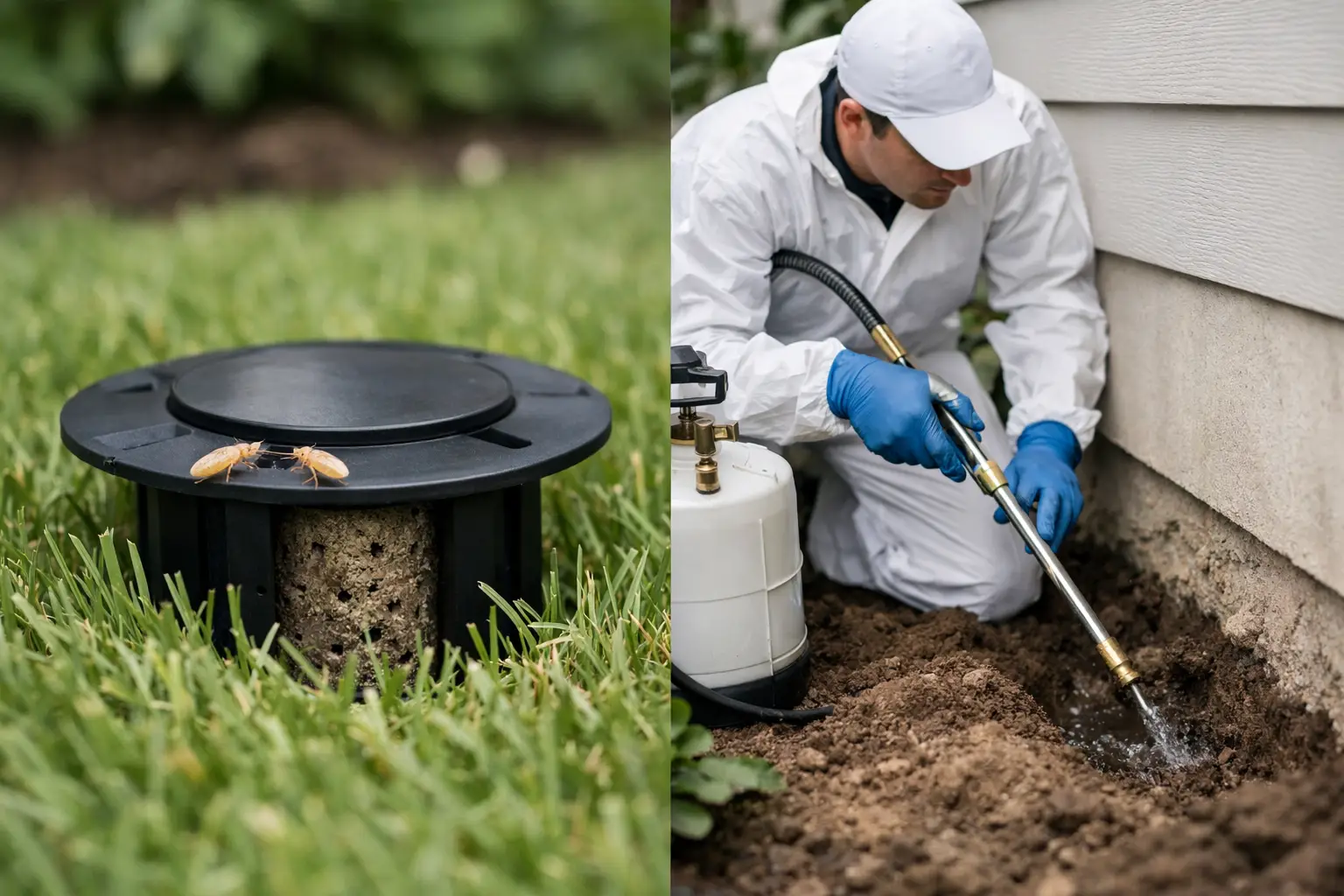
A termite baiting system is designed to target the termite colony rather than just the termites currently visible at a damaged area. Stations are installed around the property or placed directly where active termite activity is found. These stations contain a monitored material that termites feed on and share with other colony members.
Once termites begin feeding on the bait, a slow-acting active ingredient interferes with their ability to grow and maintain their bodies. Because it does not act immediately, affected workers have time to transfer the bait through the colony. Over time, this may suppress or eliminate the colony responsible for the infestation.
Baiting is especially useful where drilling or extensive soil treatment is impractical. This can include properties with tiled floors, landscaped areas, sensitive interior finishes, or construction details that make complete chemical barriers difficult to achieve. It is also a measured approach for properties where minimizing treatment impact is a high priority.
The trade-off is time. Baiting depends on termites finding and feeding on the stations, so results are not always immediate. Stations also need professional monitoring. A bait system left unchecked is not a complete termite management program.
When baiting may be the better fit
Baiting can be a strong option when there is clear evidence of active termites but limited access to the soil around the structure. It can also suit properties with complex foundations, shared walls, extensive hardscaping, or areas where occupants want to avoid broad treatment applications.
For commercial sites, baiting can be practical when operations cannot tolerate major disruption. Offices, retail spaces, F&B premises, and managed facilities often need termite control that can be carried out carefully around occupied areas. The treatment plan must still account for hygiene requirements, site access, and the condition of the building.
Baiting is not a shortcut. It works best when supported by inspections that identify activity, moisture issues, timber-to-soil contact, and likely entry points. The objective is not only to get termites feeding at a station, but to understand why they were able to reach the building in the first place.
How soil treatment works
Soil treatment creates a treated zone in the ground around or beneath a structure. A professional applies a registered termiticide to targeted soil areas so termites encounter the treated zone as they attempt to enter the building. Depending on the property, this may involve trenching external perimeter areas, treating accessible subfloor soil, or drilling through concrete at carefully planned points.
The main benefit is immediate defensive coverage. Rather than waiting for termites to locate bait, soil treatment is intended to form a protective barrier along known or likely access routes. For an active infestation, it can also help stop termites from continuing to travel between the soil and the structure.
This approach is often suitable for properties where termites are entering through accessible perimeter soil or where there is a clear need for broad, lasting protection. It can be particularly valuable after construction work, landscaping changes, water leaks, or previous termite activity has increased the risk of access around the building.
What affects soil treatment performance
Soil treatment is highly dependent on coverage and site conditions. An untreated gap can become a route for termites, especially around pipes, expansion joints, utility penetrations, additions, or concealed foundation features. This is why a professional survey matters before treatment begins.
The building design also affects the scope of work. A detached home with accessible external soil may be more straightforward than a unit with full perimeter concrete, raised decks, built-in cabinetry, or adjoining properties. In some cases, drilling is necessary to reach soil beneath slabs. A responsible provider should explain where treatment will be applied, why access is needed, and how the area will be restored afterward.
Soil treatment is not a guarantee that termites will never appear again. Changes in moisture, construction, landscaping, and neighboring termite pressure can create new conditions over time. Periodic inspections remain a sensible part of long-term property protection.
Termite baiting vs soil treatment: key differences
The clearest difference is the treatment target. Baiting aims to affect the colony through feeding behavior. Soil treatment aims to protect the building by treating termite travel routes in the ground.
Baiting is generally less intrusive at the start, but it requires patience and scheduled monitoring. Soil treatment can provide faster perimeter protection, but may require drilling, trenching, or access to difficult areas. Neither method should be selected solely because it appears simpler or less expensive upfront.
Cost also varies with the property. Baiting usually involves installation plus ongoing inspections and maintenance. Soil treatment costs depend on perimeter length, accessibility, flooring, construction type, and the amount of targeted drilling or trenching required. The more useful question is whether the recommended solution addresses the actual risk, not which method has the lower initial price.
There are also situations where a combined strategy is appropriate. Soil treatment may be used to defend vulnerable access points, while bait stations are installed to monitor termite pressure and support colony control. This can be particularly effective for properties with a history of termites or conditions that cannot be fully corrected, such as nearby mature landscaping, shared boundaries, or hard-to-access construction zones.
What a professional termite inspection should identify
A proper termite recommendation starts with evidence, not assumptions. During an inspection, a technician should look for active mud tubes, damaged timber, live termites, moisture sources, cracks and service penetrations, wood debris, and direct contact between soil and building materials.
The inspection should also consider the property as a whole. A leaking pipe behind a bathroom wall, poor drainage near an exterior wall, or stored timber against the building can all make termite activity more likely. Treating the termites without addressing these conditions can leave the property exposed to future problems.
In Singapore’s warm, humid environment, subterranean termite pressure can remain a concern throughout the year. That makes timely inspection especially valuable when you notice blistering paint, hollow-sounding wood, sagging frames, mud trails, or unexplained damage around doors, skirting boards, and cabinets.
At Servcare, termite solutions are planned around the property, the infestation findings, and the level of protection required. This includes professional assessment, science-backed treatment methods, and practical guidance on reducing conditions that attract termites.
Choosing the right protection for your property
Choose baiting when colony-focused control, minimal initial disruption, and ongoing monitoring are the best fit for the site. Consider soil treatment when the property needs a direct defensive barrier around known or likely termite entry routes. Where risk is higher or access is complex, combining both methods may provide stronger coverage than relying on one approach alone.
Avoid relying on visible damage to judge the scale of a termite problem. The termites you can see may represent only a small part of activity occurring behind walls, under floors, or below ground. Store-bought sprays can kill exposed insects but rarely address the colony or concealed entry routes.
The most helpful next step is a professional inspection before damage expands. With a clear view of termite activity, access conditions, and property risks, you can choose a treatment plan that protects more than the area where termites were first discovered.